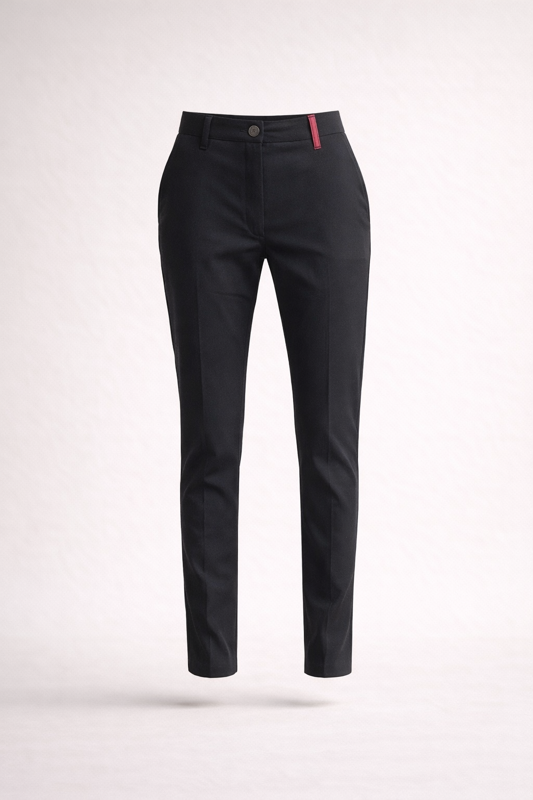
"Eco-friendly." "Conscious Collection." "Made with recycled materials." Today, anyone scrolling through fashion catalogs or online shops will come across these terms everywhere. The problem: they mean almost nothing legally. There is no obligation to provide evidence of what lies behind such claims. This article shows you how to recognize genuine sustainability – and when you are dealing with a marketing claim.
What greenwashing is and why it is so widespread
Greenwashing refers to the practice of making a product or company appear more sustainable than it actually is. This is particularly widespread in the fashion industry because consumers are increasingly looking for sustainable options while having almost no way to verify claims.
The pattern is always similar: A brand launches a "sustainable line" that makes up five percent of its range and communicates it as if the entire company were on track. Or individual materials are highlighted (for example, "made from recycled plastic bottles") without mentioning that the rest of the product is made using conventional, resource-intensive methods.
"Eco-friendly" "Green" "Conscious" "Responsible" "Better Cotton" without certification "Made with sustainable materials" without quantity specification "We care about the planet"
The most common greenwashing tactics in fashion
1. The single-feature problem. A pair of trousers is advertised as "sustainable" because the zipper is made from recycled material. The fabric itself: conventional polyester made from fossil fuels, dyed with harmful substances, and manufactured under unknown conditions. A sustainable detail does not make a sustainable product.
2. Vague percentage figures. "Made with 20% recycled materials" sounds like something. But 20 percent also means that 80 percent are not recycled. Without context and comparison, the figure is worthless.
3. Certificates without explanation. Logos on labels look trustworthy, even if no one knows what they mean. Some certifications are independently audited and strict. Others are the brand's own claims or based on minimal requirements.
4. Offsetting instead of reduction. "CO2-neutral through offsetting" does not mean that less CO2 is emitted, but that emissions are theoretically balanced elsewhere. This is better than nothing, but no evidence of a fundamentally different production model.
5. The sustainable collection alongside the main range. A "Conscious Line" with ten products in a range of a thousand items is not a sustainability concept. It is a communication tool.
How to recognize genuine transparency
| Question | Greenwashing answer | Transparent answer |
|---|---|---|
| What is the product made of? | "Sustainable materials" | Exact material composition with percentage specifications |
| Where is it produced? | "Responsibly produced" | Specific country, production partner named |
| What certificates are there? | In-house designed logo without external audit | OEKO-TEX, GOTS, EU Ecolabel – verifiable with a certificate number |
| How long does the product last? | No information | Material specifications that imply durability |
| What happens after use? | "We are working on recycling solutions" | Concrete take-back system or biodegradability with evidence |
What recognized certificates actually check
Not all labels are the same. A brief overview of the most relevant:
- OEKO-TEX Standard 100: Tests the finished product for harmful substances. Says nothing about production conditions or the environmental impact of cultivation, but is a relevant safety indicator.
- GOTS (Global Organic Textile Standard): Audits the entire supply chain from fiber to finished product – ecologically and socially. One of the strictest textile certifications.
- EU Ecolabel: European environmental label that assesses environmental impacts throughout the entire life cycle. Independently audited, legally regulated.
- Bluesign: Focuses on resource-efficient production and chemical management in the textile factory. Relevant for dyeing and finishing processes.
What all reputable certificates have in common: they are audited by independent bodies, publicly accessible, and provided with a certificate number that you can look up. If that is missing, the label is worthless.
The simplest test
Anyone who wants to know if a brand is truly transparent should ask three questions:
- What exactly is the product made of – with percentage specifications?
- Where and by whom is it produced – by name?
- What certificates are there – with a number to look up?
If a brand does not answer these three questions on its website, it is not a gap in communication. It is a decision.
What this means for purchasing decisions
Sustainability as a purchasing criterion makes sense. But it needs a foundation of verifiable facts, not marketing messages. The easiest way: pay attention to material specifications, check certificates, and question the origin of production.
And: durability is the underestimated dimension of sustainability. A garment that lasts five years and costs three times as much as a fast-fashion counterpart that is replaced after one year is the better choice in almost every respect – ecologically and economically. The price-per-wear calculation clearly shows this.
More on the topic
- Castor fiber: The material behind BREDDY'S CastorTech
- Why expensive clothing pays off in the long term
- Cotton vs. TENCEL™: What is really better for your skin?
- BREDDY'S Material Glossary – all terms explained
CastorTech (97% castor-based fiber) and TENCEL™. Produced in Europe, OEKO-TEX certified, production partner named.
To our materials → To the men's collection →