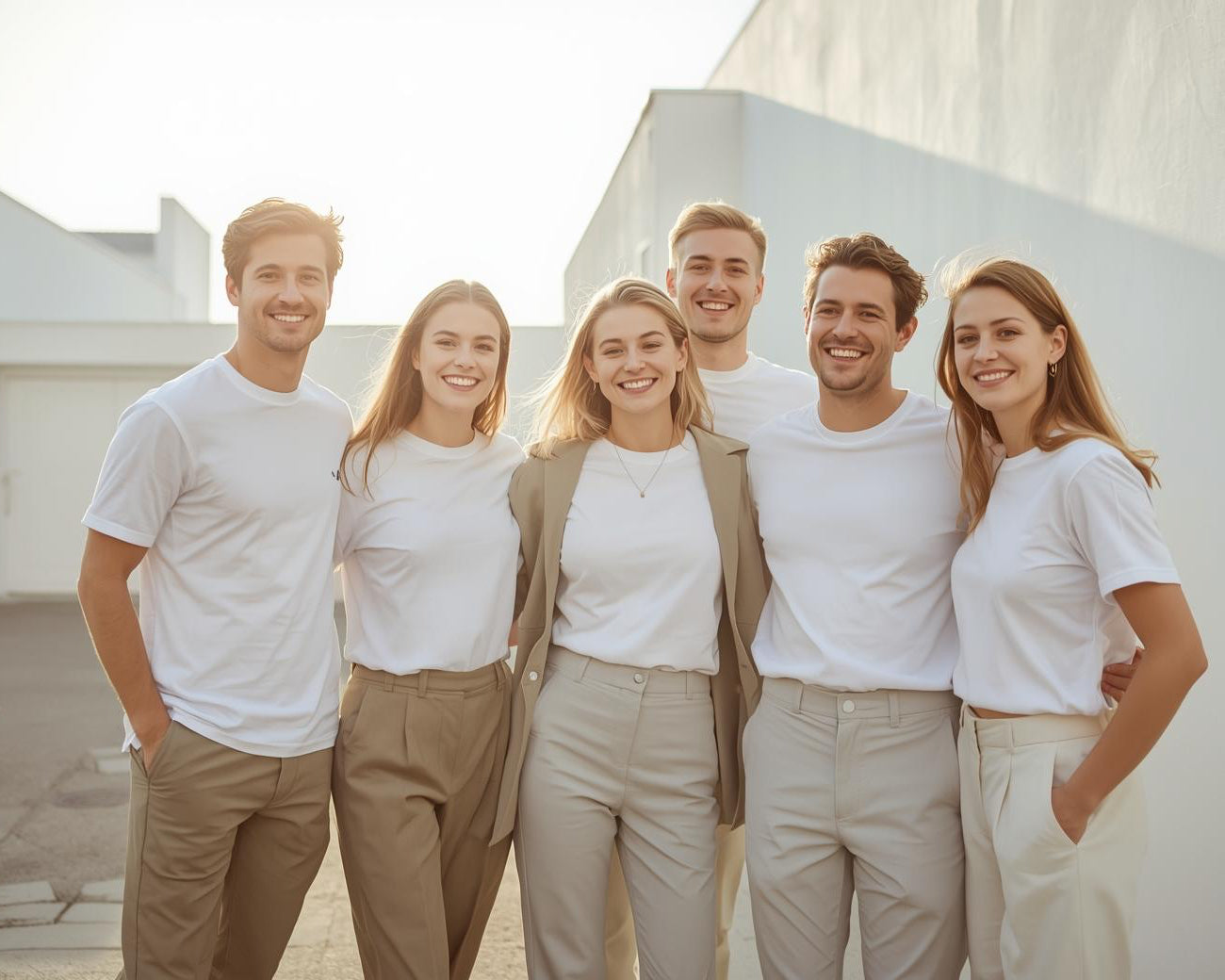
Non-iron trousers have a bad reputation. Those who grew up believing that well-kept men's trousers belong on the ironing board after washing automatically associate "non-iron" with synthetic fibers, a cheap feel, and a look that, after two hours of wear, looks like it's been stuffed in a suitcase overnight. That was justified for a long time. Not anymore.
What has changed is the material. Not the intention, but the possibilities. Modern high-performance fibers can combine properties that previously seemed incompatible: a natural feel, technical functionality, and lasting shape retention without an iron.
Where does the bad reputation come from?
The first non-iron trousers of the 1980s and 1990s were mostly made of polyester or polyester-cotton blends with chemical wrinkle-resistant treatments. The result was functional but unpleasant: The trousers did indeed hardly wrinkle, but they looked synthetic, shone in the light, and breathed poorly. For men who spend all day in the office or traveling, this was no real benefit.
The problem was not the "non-iron" concept, but the material behind it. And that is exactly where something has changed significantly in recent years.
What modern fibers can achieve today
Castor-based fibers such as the BIOS+ fabric used by BREDDY'S (45% castor, 52% polyamide, 3% elastane) are the opposite of the old polyester problem. The fiber is bio-based, has a natural, matte feel reminiscent of linen, and is technically far superior:
- Wrinkle resistance without chemicals: The fiber structure itself ensures that the trousers stay smooth. No chemical treatment, no artificial effect.
- High shape recovery: After hours of sitting, cycling, or traveling, the trousers regain their original shape – without ironing.
- Dirt- and water-repellent: Minor mishaps – coffee, rain, dust – slide off the material.
- Breathable and quick-drying: No sweating, no unpleasant sticking on warm days.
Non-iron in everyday life: What that means in concrete terms
Imagine a typical Tuesday. Morning meeting in the office, lunch appointment out of the office, dinner in the evening. A classic cotton chino will look accordingly after such a day: knee bags, seat creases, wrinkles on the thighs.
Not a pair of trousers made of high-quality BIOS+ fabric. The fiber structure has high resilience – this means the fabric returns to its original shape after stress, similar to memory foam, only in fabric. The result is a pair of trousers that still looks like it was just put on after eight hours of wear.
And after washing? Simply hang it up. No ironing board, no steam iron, no time spent. This is not a compromise – this is a concrete advantage over classic materials.
What is crucial in the cut
Material alone is not enough. A non-iron pair of trousers that stays smooth after washing but fits poorly is still not a good pair of trousers. The cut must suit the function.
At BREDDY'S, there are two cut lines for men, covering different everyday situations:
- Five Pocket: A straight, relaxed cut with the familiar denim look. Ideal for everyday wear, travel, and all situations where casualness is required, but quality is expected. What distinguishes a Five Pocket trouser from jeans: the material is lighter, easier to care for, and technically superior.
- Chino: A narrower, more structured cut for situations where a more polished look is required. The Chino from BREDDY'S combines classic looks with modern material properties – non-iron everyday suitability in a business look.
For whom non-iron men's trousers really make sense
A non-iron pair of trousers is not the right choice for everyone. Those who rarely travel, are out and about little, and wear clothes mainly in the home office may need the function less urgently.
But those who are regularly on the move in changing contexts – office, outdoor appointments, travel, dinner – pay a small price every day with classic trousers: time spent ironing, frustration over knee bags, or both. A high-quality non-iron pair of trousers solves this permanently.
In addition to this is the durability. A good piece made of BIOS+ fabric lasts significantly longer than a comparable cotton chino because the material is more resistant to common wear patterns: knee bags, fraying at the trouser legs, color loss.
What "non-iron" does not mean
Non-iron does not mean that the trousers are completely maintenance-free. They still need regular washing. The BIOS+ fabric can withstand machine washing at 40 °C and even the dryer – which further simplifies care. But dirt that has soaked in for a long time will not disappear on its own here either.
Non-iron means: no ironing necessary for a polished look. That is the difference from the classic chino, which has to go back to the ironing board after every wash if it is to look good.
More on the topic
- Castor-based fibers: What is behind BIOS+?
- Shape retention: Why it is crucial for men's trousers
- Cotton vs. TENCEL™: What is really better for your skin?
Five Pocket and Chino made of BIOS+ fabric. Developed in Vienna, made in Europe.
To the men's collection →